
Quality | Reliability | info@weldalloyproducts.in | +919811259017
ALL CONSUMABLES

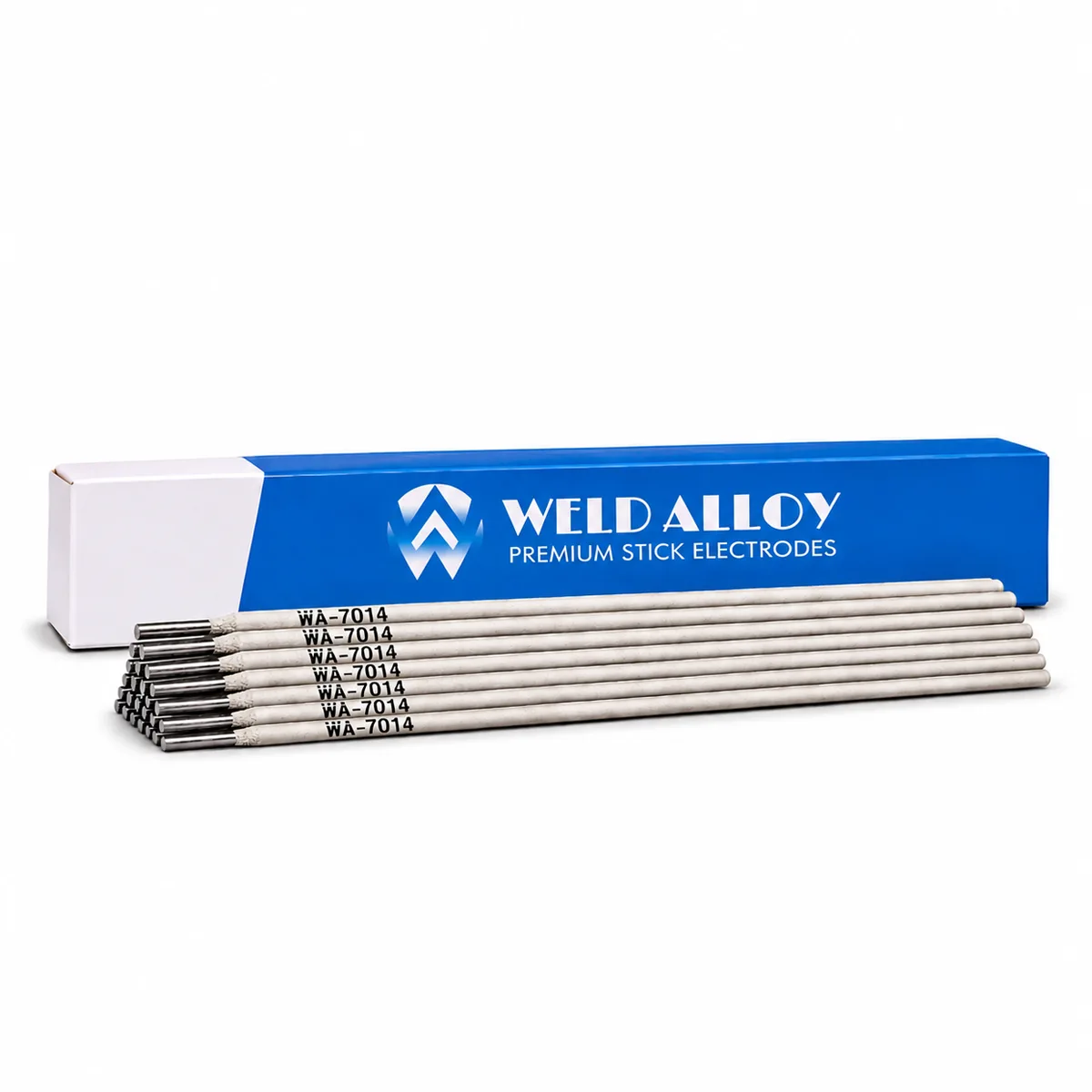
WA-7014

Heavy Coated Mild Steel Welding Electrode

WA-7014 is a heavy-coated mild steel welding electrode designed for applications requiring medium-strength welds and radiographic quality. Suitable for all welding positions, it supports high-current and high-speed welding, offering approximately 115% deposition efficiency for economical welding operations.

Identification: Name Printed
Standard Classification
AWS/SFA 5.1 E7014
BS EN E 42 O RR 33
TS/DIN E 51 32 RR 11 110
Indian Standard IS 814 ERR 5222JX
ISO 2560 E51 3RR 110 35
Current Type: DC (+) or AC
Welding Positions:
Flat
H-V
Horiz
Vertical Up (3G / PF) V-Up
Vertical Down (3G / PG) V-Down
Overhead
Radiographic-Quality Welds · Heavy-Coated· High-Speed Welding
Request a Technical Enquiry

WA-7014 is a heavy-coated electrode designed for welding steels where medium-strength and radiographic-quality welds are required. It can be operated at high currents and high welding speeds, helping improve welding economy. Its deposition efficiency is approximately 115%, as printed in the original catalogue.

Applications

  • Heavy structural fabrication.

  • Bridges.

  • Cranes.

  • Locomotives.

  • Storage tanks.

Ensure that the electrodes are dry, Rebake the electrodes at 250°C - 300°C for one hour before use for best results.

(Optionally also available in vacuum - packed condition, rebaking not required in this packaging.)

  • Keep the arc length as short as possible to prevent atmospheric nitrogen and moisture pickup.
  • Operate with stringer beads or slight weave; avoid excessive weaving.
  • Ensure joint edges are free of rust, grease, oil, and moisture prior to welding.
  • Hold electrodes in portable heated quivers (100°C–120°C) during active shift dispensing.

Weld Metal Chemistry (%) (Typical)

Chemical analysis of undiluted all-weld metal deposit conforming to AWS / IS specifications.

Typical Weld Metal Analysis
Carbon (C) 0.07%
Manganese (Mn) 0.52%
Silicon (Si) 0.40%
Sulphur (S) 0.005%
Phosphorus (P) 0.025%

Weld Metal Chemistry Table

Analysis Component C Mn Si S P
Typical Analysis (%) 0.07 0.52 0.40 0.005 0.025

Controlled sulphur and phosphorus levels ensure exceptional resistance to solidification cracking and high metallurgical soundness under heavy joint restraint.
All-Weld Mechanical Properties (Typical)

Tensile strength, yield proof, ductility elongation, and sub-zero Charpy V-Notch impact toughness.

As-Welded Condition
UTS (Tensile) 530 N/mm²
YS (Yield) 460 N/mm²
Elongation (L=4d) 26%
CVN Impact @ -20°C 85 Joules
CVN Impact @ -30°C 50 Joules

Mechanical Properties Specification Table

Test Parameter UTS (Tensile) YS (Yield) Elongation (L=4d) CVN Impact @ -20°C CVN Impact @ -30°C
Typical All-Weld Values 530 N/mm² 460 N/mm² 26% 85 Joules 50 Joules

Demonstrates high Charpy V-Notch impact resistance down to -30°C, offering superior reliability in low-temperature and dynamic fatigue service conditions.

Welding Currents & Operating Parameters

Recommended amperage ranges per electrode diameter and operational current type.

Current Type: DC (+) or AC

Electrode Diameters & Current Ranges

Size (mm) Current (Amps) Current Type Recommended Applications
2.50 × 350 mm 70 – 100 A DC (+) or AC Root pass welding, thin sections, all positions
3.15 × 450 mm 100–145 A DC (+) or AC General fabrication, structural frames, vertical and overhead passes
4.00 × 450 mm 150–200 A DC (+) or AC Heavy fill passes, pressure parts, high deposition rate
5.00 × 450 mm 200 – 250 A DC (+) or AC Flat and horizontal fillet joints on thick steel plates

Welding Instructions & Conditioning Protocols

Follow standard metallurgical procedures for optimum deposit quality and crack prevention.

PDF Datasheet Re-Bake: 250°C – 300°C for 1 Hour
Welding & Conditioning Instructions

Ensure that the electrodes are dry, Rebake the electrodes at 250°C - 300°C for one hour before use for best results.

(Optionally also available in vacuum - packed condition, rebaking not required in this packaging.)

  • Keep the arc length as short as possible to prevent atmospheric nitrogen and moisture pickup.
  • Operate with stringer beads or slight weave; avoid excessive weaving.
  • Ensure joint edges are free of rust, grease, oil, and moisture prior to welding.
  • Hold electrodes in portable heated quivers (100°C–120°C) during active shift dispensing.

Product Details & Technical Description

Comprehensive technical overview, metallurgical scope, and performance characteristics.

Product Description

WA-7014 is a heavy-coated mild steel welding electrode designed for applications requiring medium-strength welds and radiographic quality. Its characteristics make it suitable for heavy structural fabrication and industrial welding operations.

The electrode can be operated in all welding positions and is designed to withstand high welding currents and welding speeds. With an approximate deposition efficiency of 115%, it supports economical welding operations where higher deposition efficiency is desirable.

WA-7014 is particularly suitable for heavy structural work, bridges, cranes, locomotives and storage tanks. Its application range includes horizontal, downhand, and vertical-down welding where high welding speeds and deposition efficiency are required.

RELATED MILD STEEL ELECTRODES

Related Mild Steel Electrodes

View All Mild Steel Electrodes

Ready to Strengthen Your Next Engineering Project?
Partner with WAPL for Proven Welding Reliability.

Chat with us